
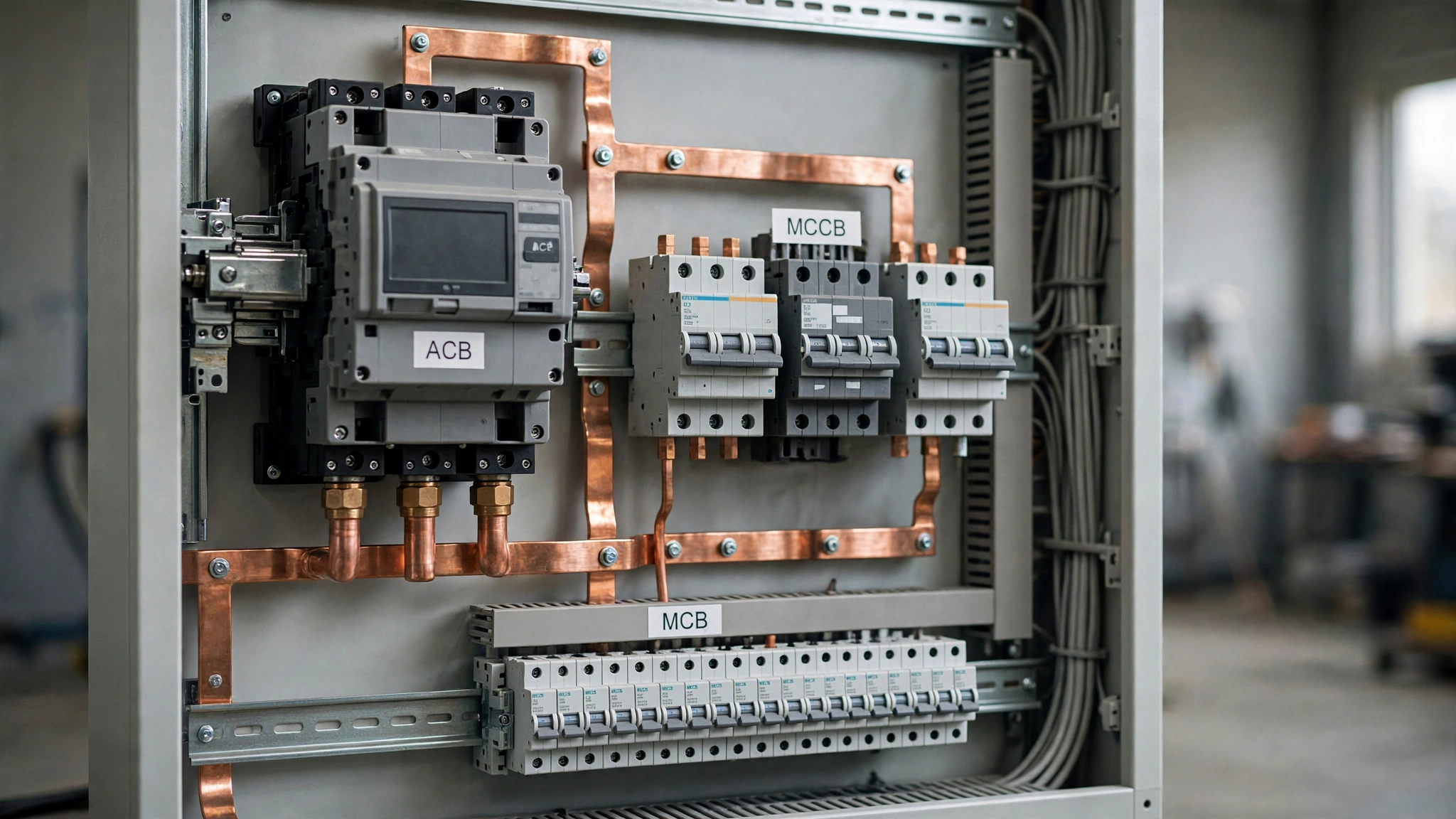
Our position
MCB for final circuits, MCCB for most of the middle, ACB for incomers that are genuinely large or must be maintained without shutting the board down. We say the winners plainly, because a comparison that ends in "it depends on your requirement" has told you nothing.
The wrong specification we see most is the ACB, and the direction is upward — bought for the drawing and for a fault level nobody calculated, on boards where an MCCB with a full Ics would have held for a fraction of the cost. The opposite error is quieter and worse: an MCB sized correctly for its load on a board whose prospective fault current exceeds what that MCB can interrupt. The load rating is right, the board is wrong, and the label tells you nothing.
Honest cost to us: we sell ACBs, and this is us talking you out of one. Where drawout maintainability and short-time withstand are not the real requirement, the MCCB is correct, and the difference is better spent on busbar and cable work. The ACB wins when the board must hold a fault for a discrimination interval, or when the incomer has to come out while the plant runs.
In short
- MCB for final circuits, MCCB for motor feeders and sub-distribution, ACB only at the incomer
- The crossover is fault level, not current — current only tells you the frame
- The ACB is over-specified on Indian LT boards far more often than it is under-specified
- An MCB correct for its load can still be wrong for its board
- Choose the cheaper device when neither drawout maintenance nor short-time withstand is a real requirement
Direct answer
First 40–60 words of the post. Declarative, no preamble.
MCBs protect final circuits at low current and low fault levels. MCCBs cover the mid range with adjustable protection and higher breaking capacity. ACBs are for incomers and large feeders where the fault current is high and the device must be maintainable in place. The crossover points are set by fault level, not by current alone.
Credibility line
One sentence, immediately after the answer.
The ACB is the most over-specified device in the enquiries we quote and the MCB the most under-specified on breaking capacity; we correct both most weeks, and the correction on the ACB is almost always downward in price.
Figure to pull before publishing: State what VendorStocks sees in the actual order data: which of the three gets specified wrongly most often, and in which direction.
Section outline
1. The short version
- Three sentences, one per device, each naming the application it owns
2. Comparison table
- Real HTML table, never an image
- Rows: typical current range, breaking capacity range, adjustability of trip settings, maintainability, physical size, indicative cost per pole, replacement versus repair
3. Where the MCB stops being adequate
- Fault level is the limit, not current
- The scenario where an MCB is rated for the load and wrong for the board
4. Where the MCCB is the right answer
- Adjustable thermal and magnetic settings, and what that buys you in coordination
- Thermal-magnetic versus microprocessor release, linked out
- Reference the specific MCCB families VendorStocks stocks, by exact catalogue name
5. Where the ACB earns its cost
- Drawout construction and in-service maintainability
- Icw and the ability to hold a fault for a discrimination interval
- Honest note: ACBs are over-specified on Indian LT panels more often than they are under-specified
6. The verdict, by application
- Commit to a recommendation for: final circuits, motor feeders, sub-distribution, main incomer
- State the conditions under which the cheaper device is the correct call
7. Who should not use each
- One short disqualifying condition per device. This is the section AI assistants quote.